
Introduction: The Evolution of Automation in a Hyper-Digital World
Robotic Process Automation (RPA) once stood at the center of enterprise digital transformation. For years, organizations relied on RPA to eliminate repetitive tasks, reduce operational costs, and accelerate back-office efficiency. However, as we step deeper into 2026, business environments have become more complex, data-driven, and customer-centric than ever before. Consequently, relying on RPA alone is no longer enough to sustain competitive advantage.
At PMDG Technologies, we work closely with enterprises undergoing large-scale automation journeys. What we consistently observe is a clear shift: organizations are moving beyond task-based automation toward intelligent, adaptive, and AI-powered automation ecosystems. This blog explores why RPA by itself is falling short in 2026, what limitations are holding businesses back, and how intelligent automation is reshaping the future of work.
Understanding RPA: Where It Excelled and Why It Peaked
Before examining why RPA alone is insufficient, it is essential to understand what made it successful in the first place. RPA excels at mimicking human actions on structured, rule-based processes. For example, copying data between systems, generating reports, processing invoices, or validating form entries are all areas where RPA delivered rapid ROI.
However, RPA was designed for predictable environments. It thrives when inputs are structured, systems are stable, and business rules rarely change. In earlier digital eras, this was enough. Yet, in 2026, enterprises face volatile markets, unstructured data, frequent application updates, and heightened customer expectations. As a result, traditional RPA has reached a functional ceiling.
The Core Limitations of RPA in 2026
1. RPA Lacks Cognitive Intelligence
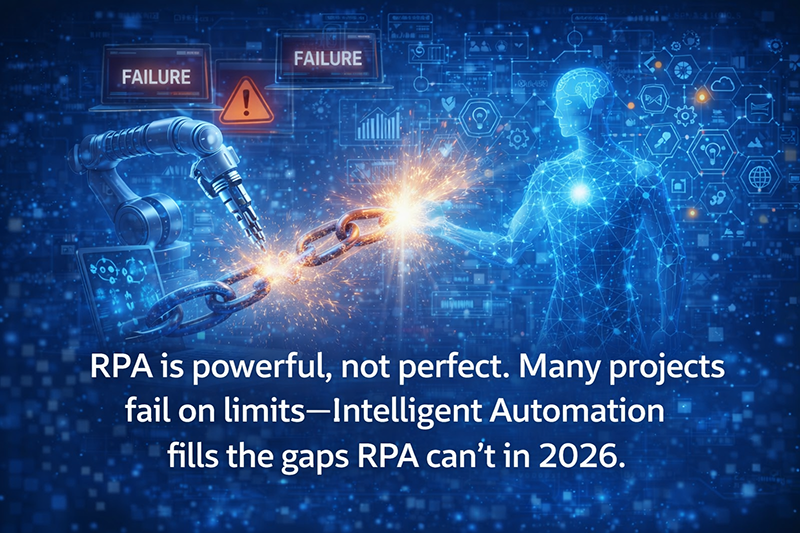
One of the most critical limitations of RPA is its inability to think, learn, or adapt. RPA bots follow predefined scripts. When data deviates from expected formats or business logic evolves, bots fail. Consequently, organizations spend significant time maintaining scripts instead of innovating.
In contrast, modern enterprises require automation that can interpret documents, understand language, recognize patterns, and make context-aware decisions. Without AI capabilities such as machine learning (ML) and natural language processing (NLP), RPA simply cannot keep pace with dynamic workflows.
2. Fragility in Rapidly Changing Systems
In 2026, applications update faster than ever. UI changes, API upgrades, and cloud-native architectures continuously evolve. Unfortunately, traditional RPA bots are highly sensitive to UI changes. Even minor interface updates can break automation flows.
As a result, organizations relying solely on RPA experience increased downtime, higher maintenance costs, and delayed releases. This fragility directly impacts business agility and scalability.
3. Limited Scalability Across End-to-End Processes
RPA works best at the task level, not at the process level. While it can automate isolated steps, it struggles to orchestrate end-to-end business processes that span departments, systems, and decision points.
In 2026, enterprises demand holistic automation that integrates data, workflows, analytics, and human collaboration. RPA alone cannot provide this level of orchestration without complementary technologies.
Why Intelligent Automation Is the New Standard
From Task Automation to Decision Automation
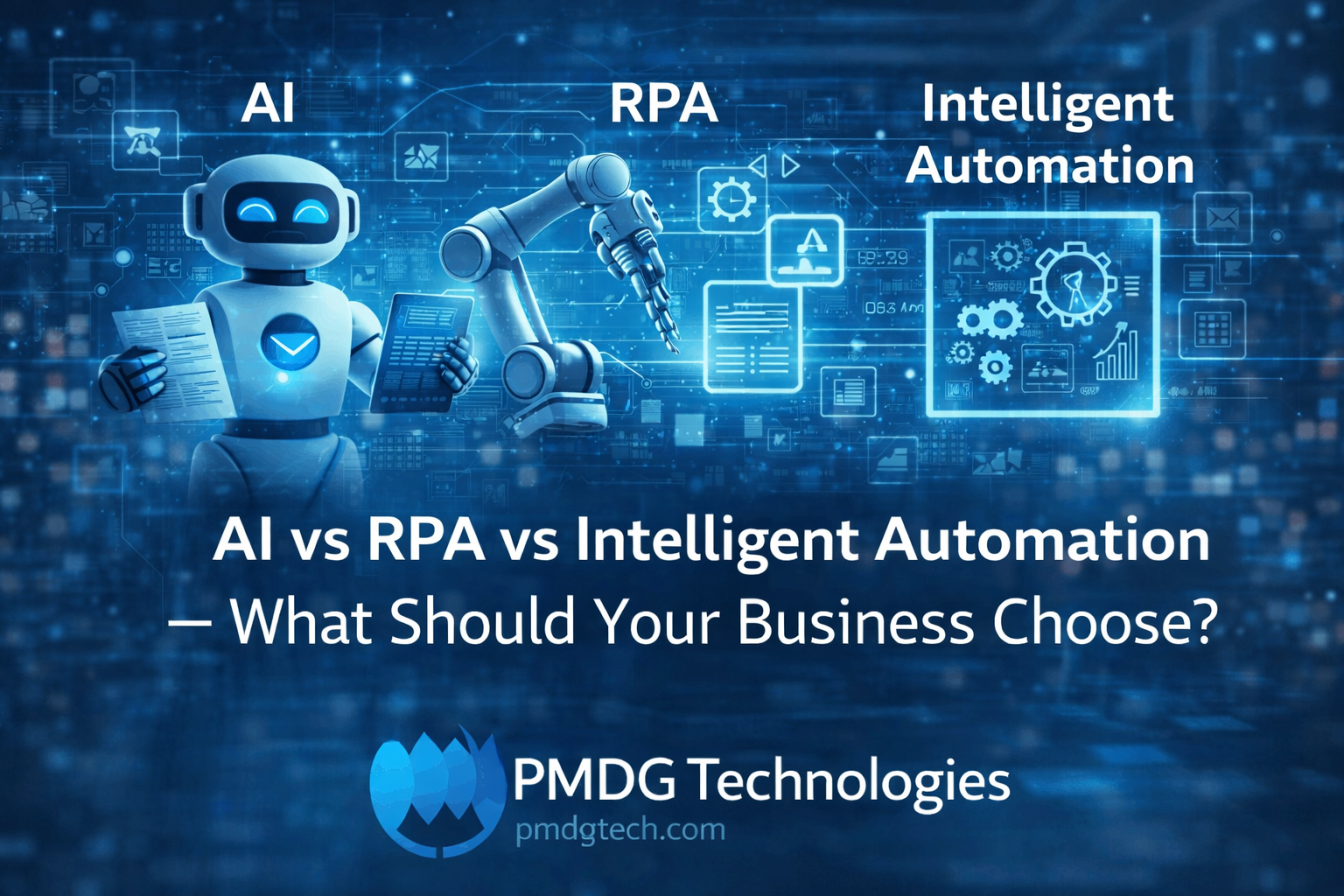
The future of automation lies in Intelligent Automation (IA)—a combination of RPA, AI, ML, NLP, process mining, and advanced analytics. Unlike traditional RPA, intelligent automation can analyze data, learn from outcomes, and continuously optimize processes.
For example, instead of merely processing invoices, intelligent automation can classify invoices, detect anomalies, predict payment delays, and recommend corrective actions. This shift from execution to decision-making is what defines automation maturity in 2026.
AI-Driven Automation Adapts in Real Time
AI-powered automation systems adapt to changes without constant human intervention. Machine learning models improve accuracy over time, while NLP enables bots to understand emails, chats, and voice inputs.
As a result, businesses achieve higher resilience, lower operational risk, and improved customer experiences—outcomes that RPA alone cannot deliver.
The Role of Hyperautomation in 2026
Hyperautomation has emerged as a top enterprise priority. It focuses on automating everything that can be automated using a combination of tools rather than relying on a single technology.
Hyperautomation integrates:
- RPA for task execution
- AI and ML for intelligence
- Process mining for optimization
- Low-code platforms for rapid deployment
- API integrations for scalability
Together, these components create a flexible automation ecosystem that continuously evolves with business needs.
Real Business Impact: Where RPA Alone Falls Short
Customer Experience Expectations Have Changed
Customers in 2026 expect instant, personalized, and seamless experiences. RPA can process transactions, but it cannot personalize interactions or understand customer intent. AI-driven automation, on the other hand, enables sentiment analysis, predictive responses, and real-time personalization.
Compliance and Risk Management Are More Complex
Regulatory environments are becoming stricter. Static RPA scripts cannot adapt to changing compliance rules. Intelligent automation continuously monitors regulations, flags risks, and ensures proactive compliance.
Data Is Unstructured and Exploding
Emails, PDFs, voice notes, videos, and social interactions dominate enterprise data today. RPA cannot process unstructured data effectively. AI-enabled automation transforms this data into actionable insights, unlocking new value streams.
The PMDG Technologies Perspective: Beyond RPA
At PMDG Technologies, we believe RPA is still valuable—but only as a component of a broader intelligent automation strategy. We help enterprises transition from basic automation to AI-first automation frameworks that deliver measurable business outcomes.
Our approach focuses on:
- Intelligent process discovery
- AI-powered automation design
- Scalable cloud-native architectures
- Continuous optimization and analytics
By combining RPA with AI, analytics, and orchestration, we enable organizations to future-proof their automation investments.
What Forward-Thinking Enterprises Should Do Now
To stay competitive in 2026 and beyond, organizations must:
- Reassess existing RPA implementations
- Identify processes that require intelligence, not just automation
- Invest in AI, ML, and process orchestration platforms
- Build scalable automation centers of excellence
- Partner with experienced automation providers like PMDG Technologies
Taking these steps ensures long-term ROI and sustainable digital transformation.
Conclusion: RPA Is Not Dead—But It Is No Longer Enough
RPA played a crucial role in the first wave of automation. However, in 2026, automation without intelligence is a strategic risk. Businesses that rely solely on RPA will struggle with scalability, adaptability, and innovation.
The future belongs to organizations that embrace intelligent automation, where RPA works alongside AI, analytics, and orchestration to deliver end-to-end value.
At PMDG Technologies, we help businesses move beyond automation silos and build intelligent, future-ready enterprises. Because in 2026, automation is not just about doing things faster—it is about doing the right things smarter.






Leave a Reply