
Introduction: Why Operational Costs Are a Silent Growth Killer
In today’s hyper-competitive digital economy, businesses are under constant pressure to do more with less. While revenue growth is important, controlling operational costs is often the real differentiator between scalable success and stalled growth. This is where AI automation becomes a game-changer.
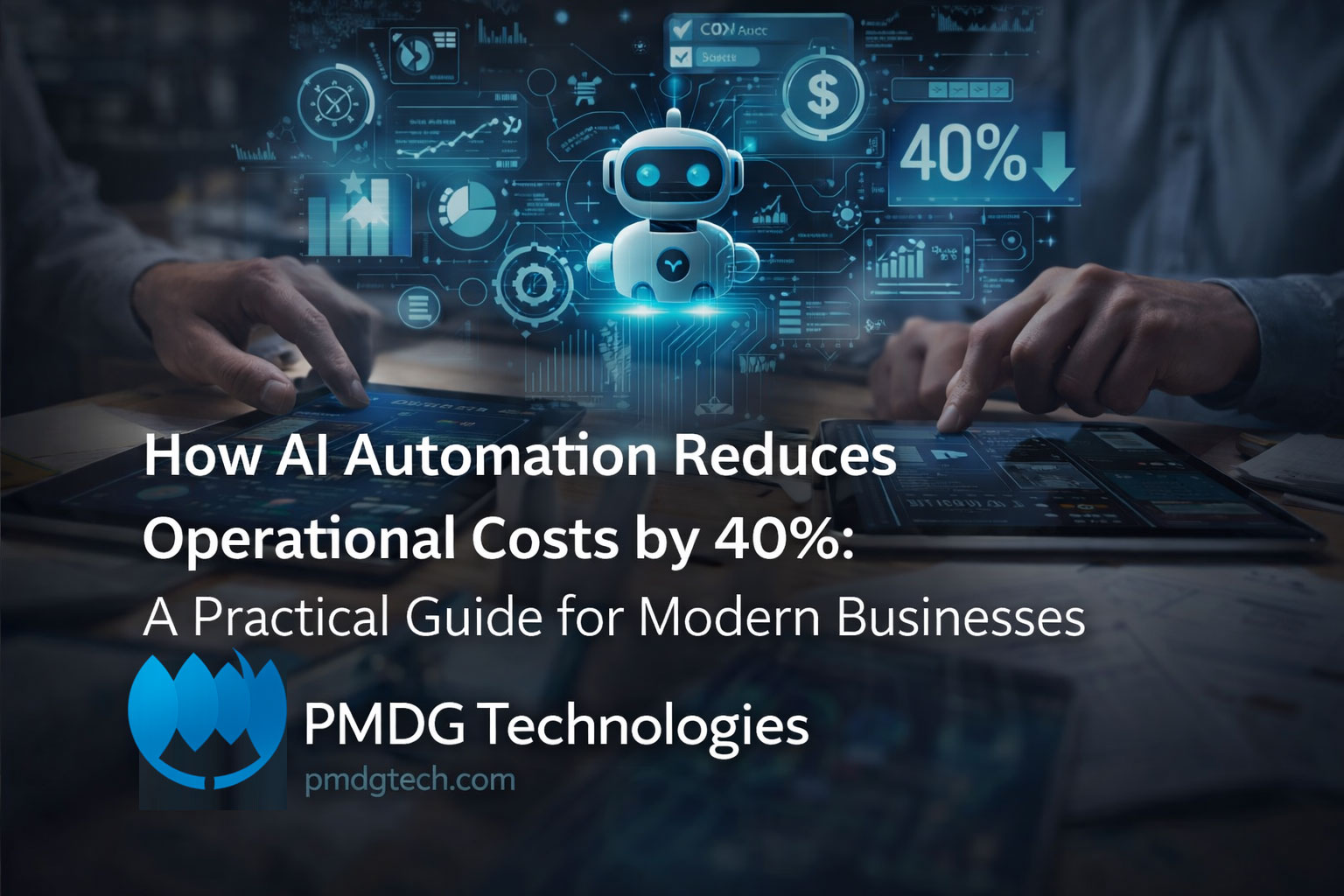
Across industries, companies adopting AI-powered automation solutions are reducing operational costs by up to 40%, while simultaneously improving speed, accuracy, and customer satisfaction. At PMDG Technologies (pmdgtech.com), we help businesses unlock this transformation by designing intelligent, scalable automation solutions tailored to real business needs.
In this in-depth guide, you’ll discover how AI automation reduces operational costs, where the savings come from, and why now is the right time to invest in AI-driven process automation.
What Is AI Automation?
AI automation combines artificial intelligence technologies—such as machine learning, natural language processing, and intelligent data extraction—with automated workflows. Unlike traditional automation, AI systems can learn, adapt, and improve over time.
As a result, businesses move beyond simple task automation and achieve intelligent process automation that handles complexity, exceptions, and decision-making with minimal human intervention.
Key AI automation components include:
- Intelligent document processing (IDP)
- AI-powered data extraction
- Robotic Process Automation (RPA)
- Predictive analytics and decision engines
- Workflow orchestration and monitoring
How AI Automation Reduces Operational Costs by 40%
1. Eliminating Manual Processes and Human Errors
First and foremost, manual processes are expensive. They consume time, require large teams, and introduce errors that lead to rework and delays. AI automation significantly reduces these inefficiencies.
For example, AI-powered document automation can extract, validate, and process data from invoices, contracts, and forms with near-perfect accuracy. Consequently, businesses reduce labor costs while eliminating costly human errors.
Cost impact:
- Reduced staffing requirements
- Lower rework and correction costs
- Faster process completion
2. Faster Turnaround Times Increase Productivity
Next, AI automation accelerates workflows dramatically. Tasks that once took hours or days can now be completed in minutes.
Because AI systems operate 24/7 without fatigue, businesses achieve higher throughput without increasing headcount. Over time, this productivity gain translates directly into lower operational costs per transaction.
Example use cases:
- Automated invoice processing
- AI-driven claims reconciliation
- Real-time data validation and reporting
3. Reduced Operational Overhead
AI automation minimizes dependence on physical infrastructure and manual supervision. Cloud-based AI systems reduce costs related to office space, hardware, and administrative overhead.
Moreover, automated monitoring and alerts ensure smooth operations without constant human oversight. As a result, management teams can focus on strategic initiatives rather than daily firefighting.
4. Intelligent Decision-Making Prevents Costly Mistakes
Another major advantage of AI automation is data-driven decision-making. AI systems analyze large volumes of operational data to identify inefficiencies, predict failures, and optimize resource allocation.
By proactively addressing issues before they escalate, businesses avoid downtime, penalties, and unexpected expenses.
Key benefits include:
- Predictive maintenance
- Demand forecasting
- Risk detection and fraud prevention
5. Scalability Without Proportional Cost Increases
Traditional operations require more people and resources as the business grows. However, AI automation scales seamlessly.
Whether you process 1,000 transactions or 1 million, AI-powered workflows handle increased volumes with minimal incremental cost. Therefore, businesses experience exponential efficiency gains as they scale.
6. Improved Compliance and Reduced Legal Risks
Compliance failures can be extremely expensive. AI automation ensures consistent adherence to regulatory standards by enforcing predefined rules and audit trails.
Furthermore, automated compliance reporting reduces the cost and effort associated with audits and regulatory checks.
Real-World Cost Savings: Where the 40% Comes From
AI automation delivers measurable savings across multiple cost centers:
- Labor costs: 20–25% reduction
- Error-related costs: 10–15% reduction
- Operational delays: 5–10% reduction
- Infrastructure and overhead: 5–10% reduction
Combined, these improvements enable businesses to achieve up to 40% operational cost savings within the first year of implementation.
Industries Benefiting Most from AI Automation
Finance and Accounting
AI automates invoice processing, reconciliation, and reporting, reducing processing costs while improving accuracy.
Healthcare
AI-powered document and data automation streamlines patient records, billing, and compliance workflows.
Insurance
Claims processing and fraud detection become faster, more accurate, and less resource-intensive.
Manufacturing
Predictive maintenance and automated supply chain management reduce downtime and waste.
Retail and E-commerce
AI automation optimizes inventory management, pricing, and customer support operations.
Why Businesses Choose PMDG Technologies for AI Automation
At PMDG Technologies, we don’t offer one-size-fits-all automation. Instead, we design custom AI automation solutions aligned with your business goals.
Our approach includes:
- Process analysis and cost-impact assessment
- AI-driven automation strategy design
- Scalable, secure solution development
- Continuous optimization and performance analytics
As a result, our clients achieve faster ROI, sustainable cost savings, and long-term operational excellence.
How to Start Your AI Automation Journey
If you’re considering AI automation, begin with these steps:
- Identify high-cost, repetitive processes
- Evaluate automation readiness
- Define clear cost-reduction goals
- Partner with an experienced AI automation provider
- Measure performance and optimize continuously
With the right strategy, AI automation becomes a powerful growth enabler rather than just a technology upgrade.
The Future of Operational Efficiency Is AI-Driven
AI automation is no longer optional—it is essential for businesses that want to remain competitive, profitable, and scalable. By reducing operational costs by up to 40%, AI automation frees resources that can be reinvested into innovation and growth.
At PMDG Technologies, we help businesses transform complexity into clarity through intelligent automation solutions.
Ready to reduce operational costs and improve efficiency? Visit www.pmdgtech.com and discover how AI automation can future-proof your business.






Leave a Reply