
Introduction: The Automation Decision Every Modern Business Faces
In 2026, automation is no longer optional—it is a strategic necessity. Businesses across industries are racing to reduce operational costs, eliminate manual errors, and improve productivity. However, when leaders begin their automation journey, one critical question often arises:
Should we choose AI, RPA, or Intelligent Automation?
Although these terms are often used interchangeably, in reality, they represent very different technologies with distinct capabilities, costs, and long-term impact. As a result, choosing the wrong approach can easily lead to wasted budgets, limited scalability, and ultimately disappointing results.
At PMDG Technologies, therefore, we help organizations design the right automation strategy by combining AI-driven solutions, intelligent workflow automation, and custom software platforms. In other words, we focus not only on technology, but also on long-term business success.
In this guide, first of all, we will clearly explain the difference between AI vs RPA vs Intelligent Automation. Then, we will highlight real-world use cases to show how each approach works in practice. Finally, we will help you decide what your business should choose in 2026 and beyond, so that you can invest confidently, scale efficiently, and achieve sustainable digital transformation.
What Is Robotic Process Automation (RPA)?
Robotic Process Automation, or RPA, is one of the earliest and most widely adopted forms of business automation.
How RPA Works
RPA uses software “bots” that mimic human actions on existing systems. These bots can:
- Click buttons and navigate applications
- Copy and paste data between systems
- Fill forms and generate reports
- Trigger rule‑based workflows
RPA follows strict, predefined rules and works best with structured, repetitive processes.
Key Benefits of RPA
- Fast deployment with minimal system changes
- Reduces manual workload and processing time
- Improves accuracy in repetitive data tasks
- Quick return on investment (ROI)
Limitations of RPAHowever, first and foremost, RPA has several important limitations that businesses must carefully consider.
To begin with, it cannot handle unstructured data such as documents, emails, or images, therefore requiring manual intervention.
Moreover, it cannot learn from experience or adapt to new situations, as a result limiting long-term scalability.
In addition, it breaks easily when applications or user interfaces change, consequently increasing maintenance costs and downtime.
Finally, it offers only limited decision-making capability, which means that complex business processes cannot be automated effectively.
Best RPA Use Cases
RPA is ideal for:
- Invoice data entry
- Payroll processing
- Order management
- Customer onboarding workflows
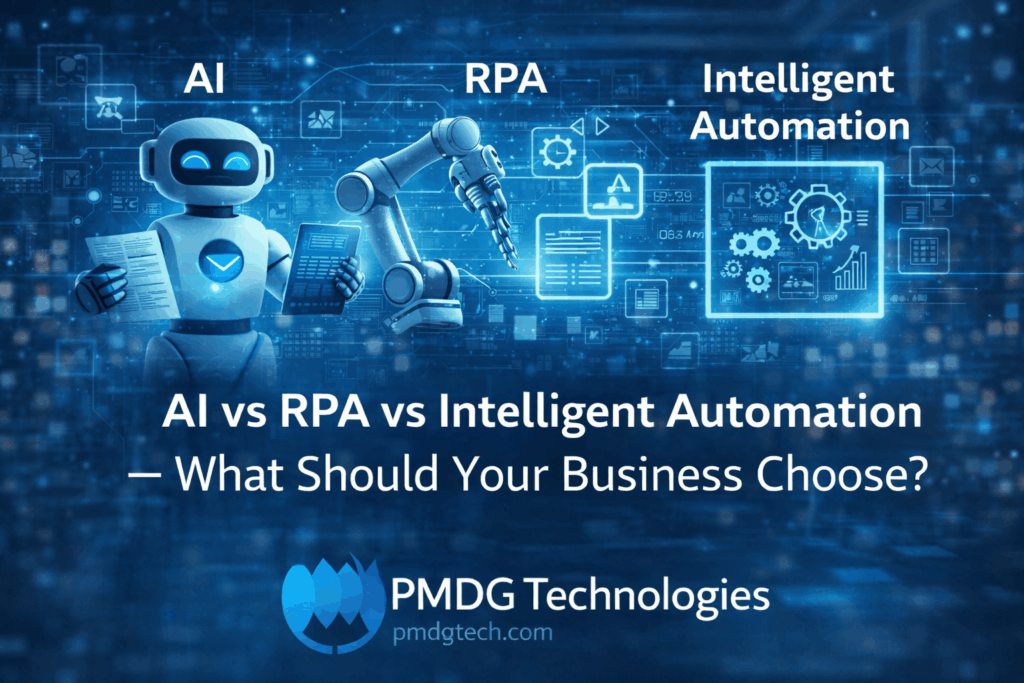
In short: RPA is excellent for rule‑based automation but lacks intelligence.
What Is Artificial Intelligence (AI) Automation?
Artificial Intelligence automation uses machine learning, natural language processing (NLP), and computer vision to simulate human intelligence.
How AI Automation Works
AI systems can:
- Understand natural language
- Recognize images and documents
- Learn from historical data
- Predict outcomes and recommend actions
Unlike RPA, AI systems can process unstructured data and continuously improve over time.
Key Benefits of AI Automation
- Handles complex and unstructured information
- Learns and adapts automatically
- Enables predictive analytics and smart decisions
- Improves customer experience through personalization
Limitations of AI Automation
- Requires quality data and training models
- Higher initial investment
- Longer implementation time
- Needs expert configuration and monitoring
Best AI Use Cases
AI automation works best for:
- Document processing and OCR
- Fraud detection and risk analysis
- Chatbots and virtual assistants
- Predictive maintenance
- Intelligent customer support
In short: AI provides intelligence, learning, and adaptability—but not full process automation by itself.
What Is Intelligent Automation?
Intelligent Automation (IA) is the next evolution of business automation. It combines the strengths of RPA + AI + workflow orchestration to create fully automated, end‑to‑end business processes.
How Intelligent Automation Works
Intelligent Automation integrates:
- RPA for task execution
- AI for data understanding and decision‑making
- Workflow engines for process orchestration
- Analytics for continuous optimization
This creates automation that can think, learn, decide, and act across entire business operations.
Key Benefits of Intelligent Automation
- Automates complex, end‑to‑end workflows
- Handles both structured and unstructured data
- Reduces operational costs significantly
- Improves compliance and accuracy
- Scales easily across departments and systems
Best Intelligent Automation Use Cases
Intelligent Automation is ideal for:
- AI document processing and OCR automation
- End‑to‑end invoice and claims processing
- Customer onboarding and KYC automation
- Supply chain and logistics optimization
- Enterprise workflow automation
In short: Intelligent Automation delivers the highest business impact by combining automation with intelligence.
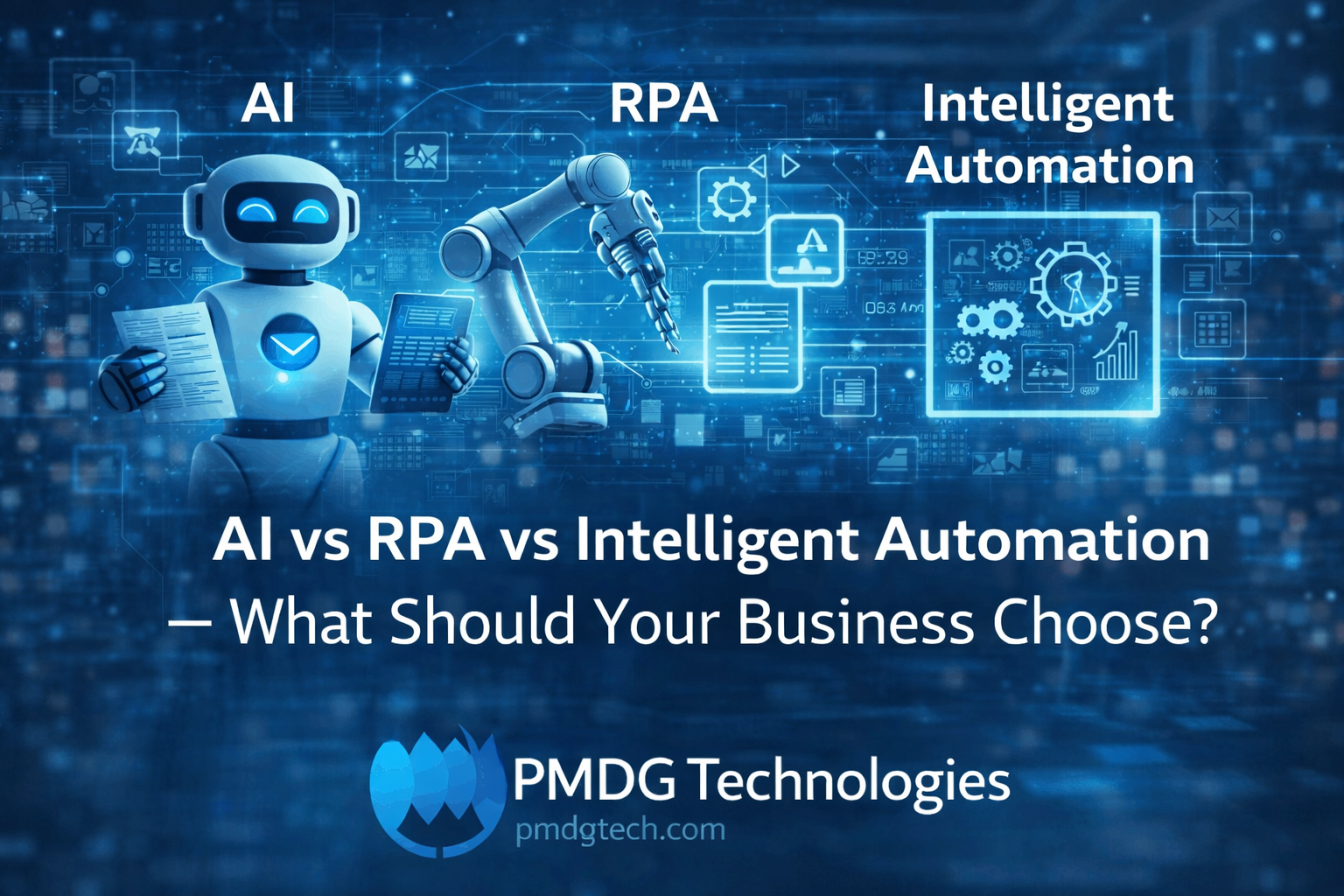
AI vs RPA vs Intelligent Automation: Key Differences
| Feature | RPA | AI Automation | Intelligent Automation |
|---|---|---|---|
| Handles structured data | Yes | Yes | Yes |
| Handles unstructured data | No | Yes | Yes |
| Learns and adapts | No | Yes | Yes |
| End‑to‑end process automation | Limited | Limited | Yes |
| Decision‑making capability | Rule‑based only | Advanced | Advanced |
| Scalability | Medium | High | Very High |
| Business impact | Task‑level | Insight‑level | Enterprise‑level |
Which Automation Technology Should Your Business Choose?
Choosing between AI, RPA, and Intelligent Automation depends on your business maturity, goals, and process complexity.
Why to Choose RPA If:
- Your processes are simple and rule‑based
- You want quick automation with low investment
- You mainly handle structured data
Choose AI Automation If:
- You work with documents, images, or natural language
- You need predictive insights and personalization
- You want systems that learn and improve
Choose Intelligent Automation If:
- You want full digital transformation
- You need end‑to‑end workflow automation
- You want scalable, future‑ready automation
- You aim to combine efficiency with intelligence
Expert Recommendation: For long‑term growth and competitive advantage, most enterprises should adopt Intelligent Automation as their primary strategy.
Why Intelligent Automation Is the Future of Business in 2026
According to industry trends, over 80% of enterprises will adopt Intelligent Automation by 2026. The reasons are clear:
- Businesses are dealing with massive volumes of unstructured data
- Customers expect faster, smarter digital experiences
- Manual operations are no longer sustainable
- AI‑first enterprises outperform competitors
Intelligent Automation delivers:
- 40–60% operational cost reduction
- Faster decision cycles
- Higher customer satisfaction
- Strong compliance and governance
How PMDG Technologies Helps You Choose and Implement the Right Automation
At PMDG Technologies, we specialize in:
- AI‑driven workflow automation
- Intelligent document processing and OCR
- RPA implementation and optimization
- Custom enterprise automation platforms
- End‑to‑end digital transformation consulting
Our experts analyze your existing processes, data structure, and business goals to design the perfect automation roadmap tailored to your organization.
Whether you need:
- Task‑level RPA deployment
- Advanced AI data processing
- Or full Intelligent Automation implementation
—we deliver scalable, secure, and future‑ready solutions.
Final Thoughts: Make the Smart Automation Choice
The debate of AI vs RPA vs Intelligent Automation is not about choosing one technology forever. Instead, it is about selecting the right automation strategy that aligns with your business vision.
- RPA improves efficiency
- AI adds intelligence
- Intelligent Automation transforms your entire enterprise
If your goal is long‑term digital leadership, Intelligent Automation is the clear winner.
Ready to Automate Smarter?
Transform your operations with AI‑powered automation solutions from PMDG Technologies.
📩 Contact us today to schedule a free automation consultation and discover how intelligent automation can future‑proof your business.






Leave a Reply