
In today’s data-driven digital economy, as a result, businesses are increasingly drowning in documents such as emails, invoices, contracts, forms, reports, and scanned files. Consequently, manually handling this growing volume of information becomes not only time-consuming but also highly error-prone and expensive. Therefore, organizations struggle to maintain efficiency, accuracy, and scalability. At this point, AI document processing emerges as a powerful solution. Ultimately, it transforms how businesses manage documents by enabling faster workflows, higher accuracy, and intelligent automation across operations.
At PMDG Technologies (pmdgtech.com), we help businesses unlock speed, accuracy, and scalability using advanced Document processing solutions. In this in-depth guide, you will learn how document processing works, why it matters, and how it delivers real business value across industries.
What Is AI Document Processing?
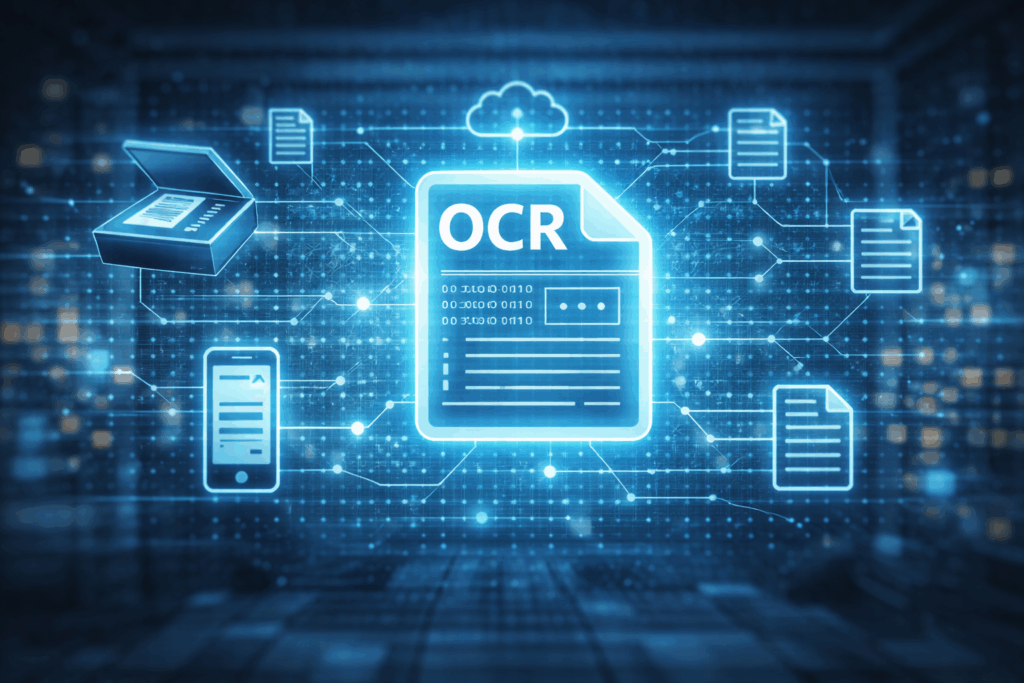
Document processing is the use of artificial intelligence, machine learning, OCR (Optical Character Recognition), and natural language processing (NLP) to automatically extract, classify, validate, and process data from documents—without manual intervention.
Unlike traditional document management systems, however, AI document processing not only understands contextual information but also continuously improves through machine learning. Moreover, it intelligently adapts to different document formats, layouts, and structures. As a result, businesses achieve greater accuracy, flexibility, and automation efficiency across complex document workflows.
Key Technologies Behind Document Processing
- OCR (Optical Character Recognition)
- Machine Learning Algorithms
- Natural Language Processing (NLP)
- Computer Vision
- Robotic Process Automation (RPA)
Together, these technologies convert unstructured documents into structured, actionable data.
Why Document Processing Is Critical for Modern Businesses
As businesses scale, consequently, document volumes increase exponentially. Therefore, relying on manual processes quickly becomes unsustainable. In response, AI document processing effectively addresses this challenge by enabling automation, thereby improving accuracy and simultaneously ensuring scalability across document workflows.
Top Business Benefits of AI Document Processing
1. Faster Document Processing Speed
As a result, AI processes thousands of documents in minutes, thereby significantly reducing turnaround time and accelerating operational efficiency.
2. Higher Accuracy with Fewer Errors
Unlike manual data entry, however, AI eliminates human errors while continuously improving accuracy through machine learning.
3. Significant Cost Reduction
By automating repetitive tasks, consequently, businesses reduce labor costs and minimize operational overhead.
4. Improved Compliance and Audit Readiness
Through consistent data handling, therefore, AI ensures validation, traceability, and regulatory compliance.
5. Scalability Without Complexity
As document volumes grow, accordingly, AI systems scale seamlessly without requiring additional staff or infrastructure complexity.
How Document Processing Works: Step-by-Step
Understanding the workflow helps businesses see the real value of AI automation.
Step 1: Document Ingestion
Documents are collected from emails, scanners, cloud storage, or enterprise systems.
Step 2: Intelligent OCR & Image Processing
AI extracts text from scanned or handwritten documents with high precision.
Step 3: AI-Based Data Classification
Documents are automatically identified—invoice, contract, receipt, or form.
Step 4: Contextual Data Extraction
Specifically, AI understands fields such as invoice numbers, dates, amounts, names, and clauses, thereby enabling accurate and contextual data extraction across documents.
Step 5: Data Validation & Enrichment
Extracted data is validated against business rules or external databases.
Step 6: System Integration
Processed data is seamlessly pushed into ERP, CRM, or accounting systems.
High-Search-Volume Use Cases of AI Document Processing
Consequently, document processing is widely adopted across industries because of its flexibility and adaptability. For instance, in finance, it automates invoice processing and reduces errors. Similarly, in healthcare, it streamlines patient record management while ensuring regulatory compliance. Moreover, in logistics, it accelerates shipping document verification, thereby improving operational efficiency. In addition, in human resources, it simplifies employee onboarding and automates payroll documentation. As a result, businesses not only save time but also reduce costs. Furthermore, because AI document processing continuously learns and adapts, it handles new document types without additional programming. Therefore, organizations can scale effortlessly while maintaining accuracy and compliance. Ultimately, this widespread applicability demonstrates why AI document processing has become essential across industries.
AI Document Processing for Finance & Accounting
- Invoice processing automation
- Expense management
- Accounts payable automation
Document Processing in Healthcare
- Patient record digitization
- Insurance claim processing
- Medical form automation
Document Processing for Logistics & Supply Chain
- Shipping documents
- Bills of lading
- Customs documentation
Document Processing for HR & Payroll
- Employee onboarding documents
- Resume parsing
- Payroll document validation
Document Processing for Legal & Compliance
- Contract analysis
- Legal document classification
- Regulatory compliance automation
AI Document Processing vs Traditional OCR: A Clear Difference
| Feature | Traditional OCR | AI Document Processing |
|---|---|---|
| Accuracy | Medium | Very High |
| Learning Capability | No | Yes |
| Context Understanding | No | Yes |
| Automation Level | Partial | End-to-End |
| Scalability | Limited | Unlimited |
Clearly, document processing is not just OCR—it is intelligent automation.
Why AI Document Processing Improves SEO-Driven Business Growth
From a business perspective, document processing directly impacts growth. For example, by automating repetitive tasks, companies thereby increase operational efficiency. Furthermore, it improves data accuracy, which in turn reduces costly errors. As a result, decision-making becomes faster and more informed. In addition, AI-driven document processing enhances customer satisfaction, because responses are quicker and more reliable. Moreover, businesses can scale operations seamlessly, while maintaining compliance and minimizing risk. Consequently, organizations not only save time but also reduce costs and gain a competitive advantage. Ultimately, leveraging document processing technology therefore drives sustainable growth, while positioning companies for long-term success in a digital economy.
- Faster decision-making
- Better customer experience
- Real-time data insights
- Improved operational efficiency
- Competitive market advantage
Therefore, companies that adopt AI early consistently outperform those that, by contrast, delay automation. For instance, early adopters gain faster insights, which in turn improves decision-making. Moreover, they streamline workflows, thereby reducing operational costs. As a result, they achieve higher productivity while maintaining better accuracy. In addition, early AI integration enhances scalability, which subsequently positions these companies ahead of competitors. Consequently, organizations that embrace AI proactively not only optimize efficiency but also secure long-term growth and competitive advantage.
Why Choose PMDG Technologies for AI Document Processing?
At PMDG Technologies, we specialize in delivering custom document processing solutions that align with your business goals.
What Makes PMDG Technologies Different?
- ✔ Industry-specific AI models
- ✔ High-accuracy document extraction
- ✔ Seamless system integrations
- ✔ Secure and compliant architecture
- ✔ Scalable enterprise-ready solutions
Rather than offering one-size-fits-all automation, instead, we design AI-driven document processing systems that continuously adapt, progressively learn, and consistently grow alongside your business.
👉 Consequently, learn more at https://pmdgtech.com
Future of AI Document Processing in 2026 and Beyond
The future of document automation is intelligent, autonomous, and predictive.
Emerging Trends:
- Self-learning AI models
- Zero-touch document processing
- AI-driven compliance automation
- Real-time decision intelligence
- Deep integration with business workflows
As AI evolves, document processing will become an invisible yet powerful backbone of digital enterprises.
Final Thoughts: Is AI Document Processing Worth It?
Absolutely.
Consequently, document processing is no longer optional; instead, it has become a strategic necessity. As a result, businesses that automate document workflows gain speed, accuracy, cost efficiency, and scalability. Therefore, if your organization still relies on manual document handling, now is the ideal time to upgrade and embrace intelligent automation.
🚀 Start your AI document processing journey with PMDG Technologies today.









Leave a Reply