

Introduction
In today’s highly competitive digital economy, businesses can no longer rely on disconnected systems, spreadsheets, and manual processes to manage operations. As organizations continue to expand across multiple departments, locations, and digital channels, the demand for intelligent and scalable Custom ERP Software has increased significantly.
According to recent market reports, the global ERP software market is expected to surpass $130 billion by 2028, driven primarily by AI integration, cloud adoption, workflow automation, and real-time analytics. Consequently, companies are investing heavily in modern ERP solutions that can centralize operations, improve visibility, and enhance decision-making.
However, not all ERP systems deliver the same value. While traditional ERP platforms often struggle with flexibility and scalability, modern custom ERP software provides organizations with tailored functionality designed specifically for their operational requirements.
Therefore, understanding the essential features of a modern ERP system has become crucial for business leaders, IT managers, and digital transformation teams.
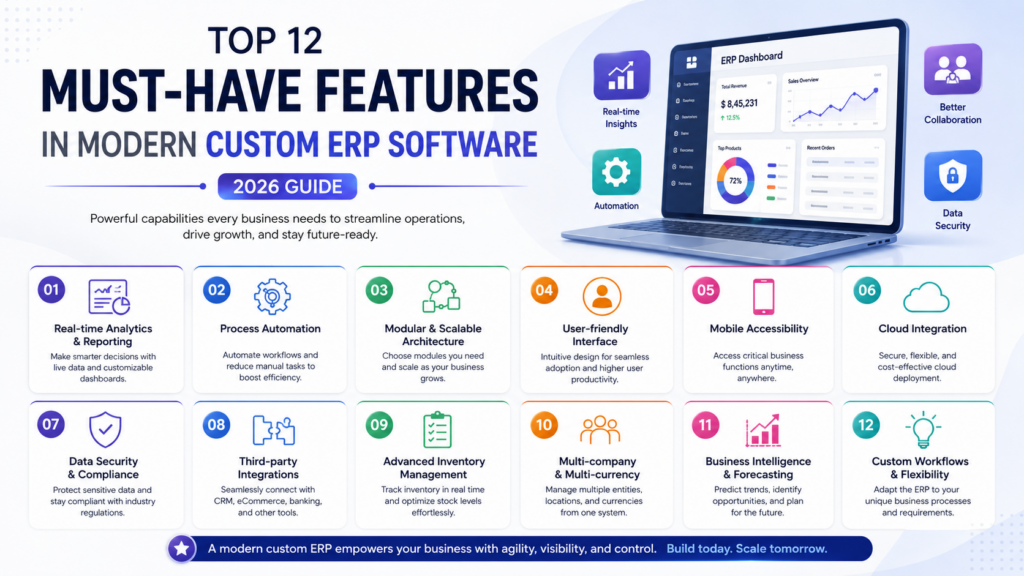
In this comprehensive guide, we will explore the Top 12 Must-Have Features in Modern Custom ERP Software for 2026, explain why they matter, and demonstrate how they solve real-world business challenges.
Why Businesses Are Moving Toward Custom ERP Software
Before discussing the features, it is important to understand why custom ERP solutions are rapidly replacing generic ERP platforms.
Modern businesses face several challenges, including fragmented data, delayed reporting, operational inefficiencies, compliance risks, customer service issues, and increasing competition. As a result, organizations need systems that align perfectly with their workflows instead of forcing teams to adapt to rigid software structures.
Custom ERP software addresses these concerns by offering personalized workflows, industry-specific modules, enhanced security controls, AI-driven automation, and seamless integration capabilities.
Moreover, custom ERP systems grow alongside the business, making them a future-proof investment.
1. AI-Powered Business Intelligence and Predictive Analytics
Artificial Intelligence has become one of the most transformative technologies in enterprise software. Therefore, modern ERP platforms must include AI-powered business intelligence capabilities.
Instead of simply displaying historical reports, advanced ERP systems analyze massive volumes of business data and identify patterns, trends, and future opportunities. Consequently, executives can make proactive decisions rather than reactive ones.
For example, an AI-powered ERP system can forecast inventory shortages before they occur, predict customer demand fluctuations, identify potential financial risks, and recommend operational improvements.
Furthermore, machine learning algorithms continuously improve predictions by learning from organizational data. As a result, businesses gain more accurate insights over time.
Organizations implementing AI-driven ERP systems often experience improved forecasting accuracy, reduced operational costs, and enhanced strategic planning.
2. Real-Time Data Synchronization Across Departments
One of the biggest challenges businesses face is data inconsistency between departments.
Sales teams often operate with different information than finance teams, while inventory departments may not have real-time visibility into procurement activities. Consequently, delays and costly mistakes become common.
Modern custom ERP software solves this problem through real-time data synchronization.
Whenever a transaction occurs, information updates instantly across all connected modules. Therefore, every department works from the same source of truth.
For instance, when a sales order is created, inventory levels automatically adjust, accounting receives updates, procurement receives alerts, and management dashboards reflect the latest information.
As a result, decision-making becomes faster, collaboration improves, and operational errors decrease significantly.
3. Cloud-Based Architecture for Scalability
Businesses today require flexibility and accessibility more than ever before. Therefore, cloud-native ERP architecture has become an essential feature.
Unlike traditional on-premise systems, cloud ERP software allows employees to access critical business information from anywhere using secure internet connections.
Moreover, cloud infrastructure enables businesses to scale resources based on demand. As a result, organizations avoid costly hardware investments while maintaining optimal performance.
Additionally, cloud-based ERP platforms support remote work environments, global operations, and multi-location business management.
Because software updates occur automatically, organizations also benefit from continuous innovation without significant downtime.
Consequently, cloud ERP systems provide long-term operational and financial advantages.
4. Intelligent Workflow Automation
Manual processes consume valuable time and increase the risk of human error.
Therefore, workflow automation has become a core requirement for modern ERP systems.
Intelligent workflow automation enables businesses to automate repetitive tasks such as invoice approvals, purchase requests, employee onboarding, inventory replenishment, customer communications, and compliance reporting.
Furthermore, AI-driven automation engines can analyze workflow patterns and recommend process improvements.
As a result, employees spend less time on administrative work and more time on strategic activities.
Organizations implementing workflow automation often experience faster processing times, increased productivity, and reduced operational costs.
5. Advanced Cybersecurity and Data Protection
Cybersecurity threats continue to increase globally. Therefore, ERP security should never be treated as an optional feature.
Modern custom ERP software must incorporate multiple layers of protection, including data encryption, role-based access control, multi-factor authentication, threat monitoring, and audit trails.
Moreover, businesses handling sensitive customer, financial, or healthcare information must comply with regulatory requirements.
Advanced ERP security systems help organizations maintain compliance while protecting critical assets from cyber threats.
Consequently, companies can build trust with customers, partners, and stakeholders while minimizing security risks.
6. Integrated Customer Relationship Management (CRM)
Customer expectations continue to rise across industries.
Therefore, modern ERP platforms should integrate CRM functionality directly within the system.
When CRM and ERP operate together, businesses gain a complete view of customer interactions, purchase history, support tickets, communication records, and sales opportunities.
As a result, sales teams can deliver personalized experiences while customer service departments resolve issues more efficiently.
Furthermore, AI-powered CRM modules can identify high-value leads, predict customer behavior, and recommend engagement strategies.
Consequently, organizations improve customer satisfaction and increase revenue opportunities.
7. Smart Inventory and Supply Chain Management
Supply chain disruptions have become a major concern for businesses worldwide.
Therefore, modern ERP software must include intelligent inventory and supply chain management capabilities.
Advanced ERP systems monitor stock levels in real time, track supplier performance, predict inventory requirements, and automate procurement processes.
Moreover, AI algorithms analyze demand trends and seasonal patterns to optimize stock levels.
As a result, businesses reduce inventory carrying costs while preventing stock shortages and overstock situations.
Consequently, supply chain operations become more resilient and efficient.
8. Mobile Accessibility and Remote Workforce Support
The modern workforce is increasingly mobile.
Therefore, ERP software should provide full mobile accessibility across smartphones and tablets.
Employees, managers, sales representatives, and executives need access to business data regardless of their location.
Mobile ERP applications allow users to approve workflows, monitor KPIs, access reports, manage customer interactions, and review operational metrics in real time.
As a result, organizations maintain productivity even when teams work remotely or travel frequently.
Furthermore, mobile accessibility accelerates decision-making and improves operational responsiveness.
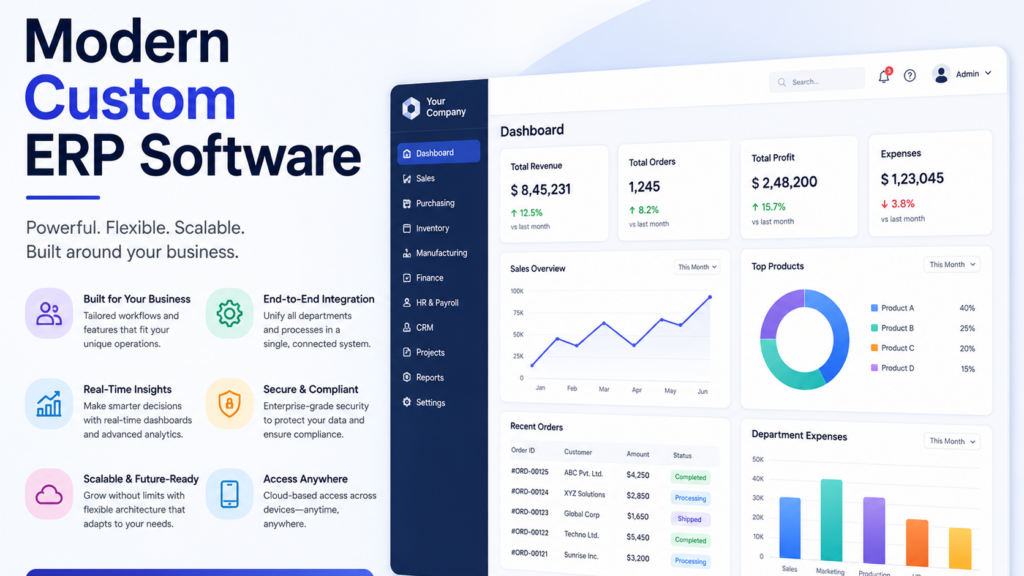
9. Advanced Reporting and Interactive Dashboards
Data-driven decision-making has become essential for business success.
Therefore, modern ERP platforms must offer advanced reporting and interactive dashboard capabilities.
Instead of relying on static reports, executives require dynamic visualizations that display real-time business performance.
Interactive dashboards provide immediate insights into sales performance, financial health, inventory levels, employee productivity, and customer engagement.
Moreover, AI-powered analytics can automatically identify anomalies and highlight areas requiring attention.
Consequently, leaders can make faster and more informed strategic decisions.
10. Seamless Third-Party Integrations
Businesses rely on numerous software applications to manage operations.
Therefore, ERP systems must support seamless integration with external platforms.
Modern ERP solutions should connect easily with payment gateways, eCommerce platforms, HR systems, accounting software, marketing tools, customer support applications, IoT devices, and AI services.
As a result, organizations eliminate data silos and create unified digital ecosystems.
Furthermore, integration capabilities improve workflow efficiency and reduce manual data entry.
Consequently, businesses achieve higher productivity and operational consistency.
11. Industry-Specific Customization
Every industry operates differently.
Therefore, modern ERP software must support extensive customization options.
Manufacturing companies require production planning tools, healthcare organizations need patient management workflows, retail businesses depend on inventory optimization, and logistics providers require fleet management capabilities.
Custom ERP development ensures the system aligns perfectly with industry requirements.
As a result, businesses avoid unnecessary complexity while maximizing operational effectiveness.
Furthermore, customized workflows increase user adoption and improve overall system performance.
12. AI-Powered Decision Support System
Modern ERP systems are evolving beyond management tools into strategic advisors.
Therefore, AI-powered decision support systems represent one of the most valuable ERP features in 2026.
These systems analyze organizational data, market trends, customer behavior, financial performance, and operational metrics.
Consequently, the ERP platform can recommend actions such as adjusting pricing strategies, optimizing inventory levels, reallocating resources, or identifying growth opportunities.
Furthermore, generative AI assistants integrated within ERP platforms enable users to ask business questions using natural language.
As a result, complex data analysis becomes accessible to everyone within the organization.
How AI Algorithms Are Transforming Modern ERP Software
AI models play a crucial role in next-generation ERP systems.
Modern ERP platforms leverage machine learning algorithms, predictive analytics models, natural language processing, anomaly detection systems, recommendation engines, and generative AI assistants.
These technologies continuously analyze business operations and identify opportunities for improvement.
As a result, organizations experience higher efficiency, better forecasting accuracy, reduced costs, and improved customer experiences.
Moreover, AI-driven ERP systems provide competitive advantages that traditional platforms cannot match.
Common Business Problems Solved by Modern ERP Systems
Many organizations struggle with disconnected software, inaccurate reporting, inventory issues, delayed decision-making, inefficient workflows, and poor customer experiences.
However, modern custom ERP software addresses these challenges by centralizing data, automating processes, enhancing visibility, and improving collaboration.
Consequently, businesses gain operational control and can focus on strategic growth initiatives.
Furthermore, AI-powered insights enable proactive decision-making, reducing risks and increasing profitability.
Future Trends in ERP Software Beyond 2026
The ERP landscape continues to evolve rapidly.
In the coming years, organizations can expect deeper AI integration, autonomous business processes, conversational ERP interfaces, advanced digital twins, IoT-driven analytics, blockchain-enabled transparency, and hyperautomation capabilities.
Therefore, businesses investing in scalable custom ERP solutions today will be better positioned for future growth.
Moreover, organizations that embrace intelligent ERP technologies early will gain significant competitive advantages.
Conclusion
Modern businesses require more than basic management software. They need intelligent, scalable, secure, and highly customized ERP solutions that can adapt to changing market conditions.
The Top 12 Must-Have Features in Modern Custom ERP Software discussed in this guide represent the foundation of successful digital transformation initiatives in 2026.
From AI-powered analytics and workflow automation to cloud scalability, cybersecurity, CRM integration, mobile accessibility, and intelligent decision support, these capabilities help organizations improve efficiency, reduce costs, and drive sustainable growth.
As competition continues to intensify, investing in a future-ready custom ERP system is no longer a luxury. Instead, it has become a strategic necessity for businesses seeking long-term success in the digital era.
Call to Action:
Looking to build a custom AI-powered ERP solution tailored to your business needs? Partner with expert ERP developers to create a scalable, secure, and intelligent platform that accelerates growth and maximizes operational efficiency.
