
Robotic Process Automation (RPA) has been celebrated for over a decade as the ultimate solution for repetitive manual tasks. From data entry to invoice processing, RPA bots have saved thousands of hours for enterprises worldwide.
However, as we step into 2026, many organizations are realizing something important:
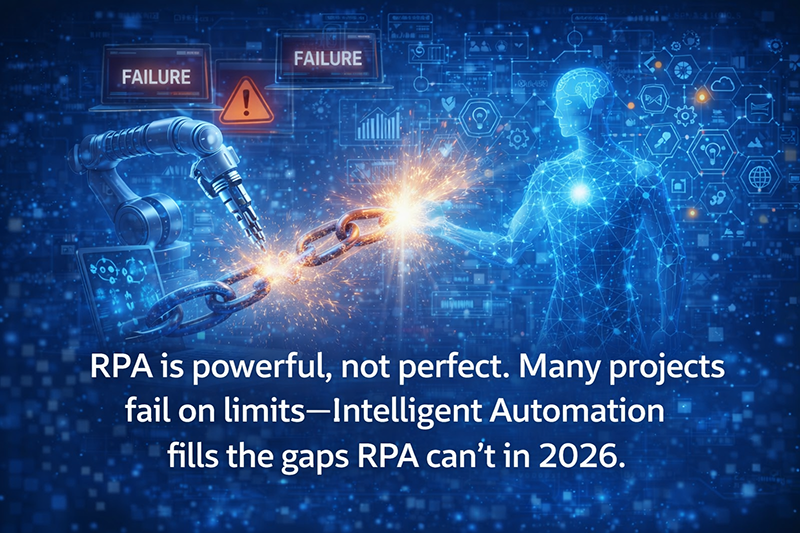
RPA works well… until it doesn’t.
While vendors and case studies highlight success stories, very few talk about the hidden limitations of RPA that start appearing when businesses attempt to scale automation beyond basic tasks.
Consequently, companies investing heavily in RPA are now facing unexpected roadblocks, bot failures, maintenance nightmares, and poor ROI.
So, what are these hidden limitations? And more importantly, how can businesses overcome them?
Let’s break it down.
1. RPA Works Only With Structured, Rule-Based Processes
One of the biggest limitations of RPA is that it can only operate where clear rules exist.
RPA bots:
- Follow predefined steps
- Work on structured data
- Cannot make judgments
- Cannot handle ambiguity
However, real business processes are rarely this simple.
For example:
- Emails from customers are unstructured
- Invoices come in multiple formats
- Documents vary from vendor to vendor
- Decisions often require human judgment
As a result, RPA struggles the moment variability enters the process.
2. RPA Breaks When Applications Change
This is a pain point many IT teams quietly deal with.
RPA bots depend heavily on:
- UI elements
- Screen positions
- Application layouts
Even a small UI update in an application can break the bot.
Therefore, teams spend more time fixing bots than benefiting from automation.
This is one of the most underestimated RPA challenges organizations face after deployment.
3. RPA Cannot Handle Unstructured Data
Modern businesses deal with:
- PDFs
- Emails
- Scanned documents
- Images
- Voice inputs
Unfortunately, traditional RPA cannot read, understand, or interpret such data.
Hence, companies end up creating manual pre-processing steps, which defeats the purpose of automation.
This is where many RPA projects silently lose efficiency.
4. Scaling RPA Is Expensive and Complex
Initially, RPA looks cost-effective. But when organizations try to scale:
- More bots are required
- More licenses are needed
- More monitoring is required
- More maintenance teams are needed
Eventually, the cost of maintaining bots exceeds the expected ROI.
Thus, RPA becomes operational overhead instead of operational efficiency.
5. RPA Has No Intelligence or Learning Ability
RPA bots do not learn from data.
They cannot:
- Improve over time
- Adapt to new patterns
- Predict outcomes
- Make decisions
In contrast, today’s business environment demands systems that can learn and evolve.
This is a critical drawback of RPA in the AI era.
6. RPA Projects Often Fail Due to Poor Process Selection
Many companies automate the wrong processes.
They choose processes that:
- Change frequently
- Lack clear rules
- Depend on human decisions
As a result, bots fail repeatedly, and projects are labeled unsuccessful.
This is one of the primary reasons behind RPA failures globally.
7. RPA Requires Constant Human Supervision
Contrary to popular belief, RPA is not “set and forget”.
Bots require:
- Monitoring
- Error handling
- Exception management
- Regular updates
Therefore, instead of eliminating human effort, RPA shifts the effort from operations to bot management.
8. RPA Cannot Deliver End-to-End Automation
RPA can automate parts of a process, not the entire workflow.
For example:
- It can extract data
- But cannot validate it intelligently
- It can move files
- But cannot understand context
Hence, human intervention remains necessary.
9. RPA Struggles With Decision-Based Workflows
Business processes often involve decisions such as:
- Approvals
- Risk analysis
- Customer prioritization
- Exception handling
RPA cannot make such decisions.
This limits RPA to task automation rather than process automation.
10. ROI of RPA Declines Over Time
Initially, RPA shows quick wins.
However, over time:
- Maintenance increases
- Complexity increases
- Failures increase
- Costs increase
Therefore, long-term ROI starts declining.

Why These Limitations Were Not Visible Earlier
Earlier, businesses automated only simple back-office tasks.
But now, companies want to automate:
- Customer interactions
- Document processing
- Decision workflows
- Complex operations
That’s where RPA starts showing its boundaries.
The Shift From RPA to Intelligent Automation
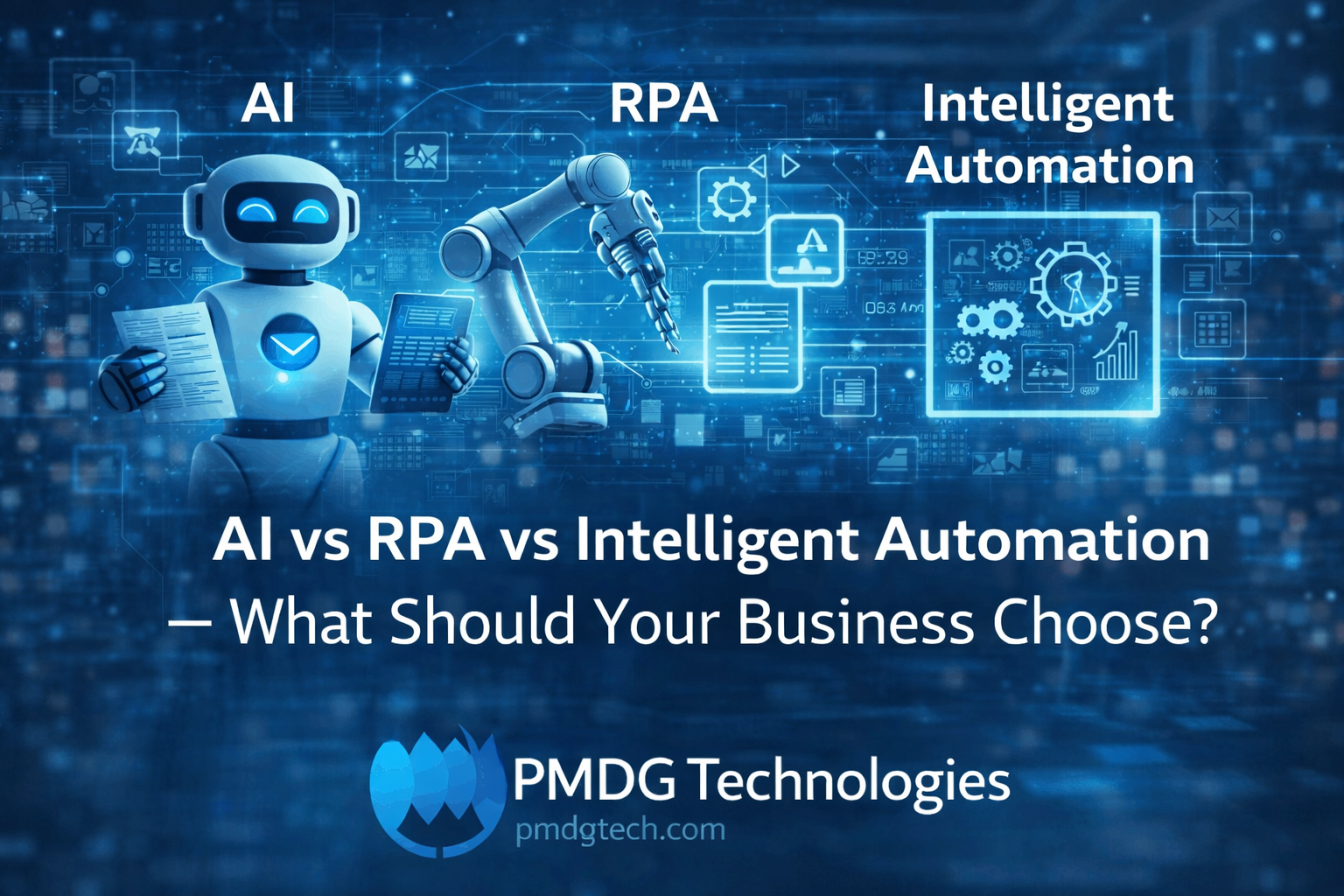
Because of these limitations of RPA, organizations are now moving toward Intelligent Automation.
Intelligent Automation combines:
- RPA for task execution
- AI for decision making
- OCR for document reading
- Machine learning for improvement
As a result, businesses achieve true end-to-end automation.
RPA vs Intelligent Automation: The Key Difference
| Capability | RPA | Intelligent Automation |
|---|---|---|
| Rule-based tasks | ✅ | ✅ |
| Unstructured data handling | ❌ | ✅ |
| Learning ability | ❌ | ✅ |
| Decision making | ❌ | ✅ |
| Scalability | Limited | High |
| Maintenance | High | Low |
| End-to-end automation | ❌ | ✅ |
How Businesses Can Overcome RPA Limitations
To overcome RPA challenges, organizations should:
- Combine RPA with AI technologies
- Use OCR for document understanding
- Implement intelligent workflows
- Automate decision points with ML models
- Design automation architecture, not just bots
The Future of Automation in 2026 and Beyond
The future is not about replacing RPA.
Instead, it’s about enhancing RPA with intelligence.
This is called:
- Hyperautomation
- Intelligent Automation
- Autonomous Automation
And this is where forward-thinking companies are investing.
Key Takeaway for Businesses
RPA is still valuable. However, relying on RPA alone is no longer enough.
Organizations that recognize the hidden limitations of RPA early can transition smoothly to smarter automation strategies.
Those who don’t may continue fixing bots instead of transforming operations.
Conclusion: Awareness Is the First Step Toward Better Automation
RPA started the automation revolution. But now, businesses must evolve.
Understanding the limitations of RPA allows companies to:
- Avoid costly mistakes
- Choose the right automation approach
- Build scalable automation strategies
At PMDG Technologies, we help businesses move beyond basic RPA toward intelligent, future-ready automation solutions that truly transform operations.









Leave a Reply